
Intersection Crash Frequency Analysis Considering Visual Environment Features Using Random Parameter Negative Binomial-Lindley Model
Published in Transportation Research Record, 2025
Authors
Lei Han*, Mohamed Abdel-Aty, Yang-Jun Joo, Shaoyan Zhai, Dongdong Wang
Abstract
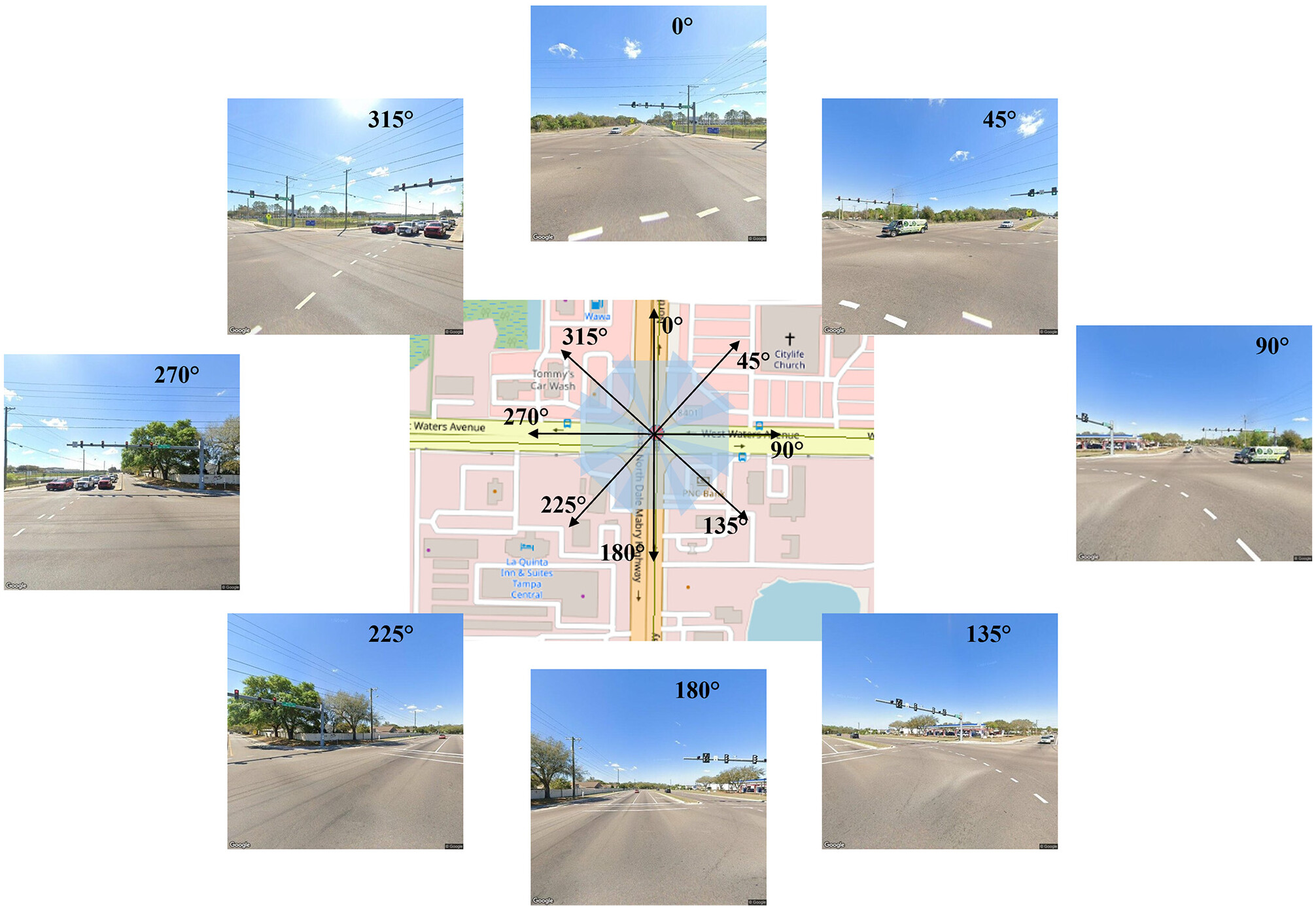
Existing intersection crash analysis studies primarily consider macro infrastructure and traffic conditions. However, drivers' micro-level visual perception of the surrounding environment also affects their driving behaviors and, thus, safety, and this has not been fully investigated yet for intersection crash modeling. Leveraging recent image semantic segmentation techniques, this study extracts six types of visual object from Google Street View (GSV) images: sky, road, buildings, vegetation, vehicles, and walk area. Their pixel proportions were then aggregated as the drivers' visual environment features. These features, along with geometric design, traffic, and socioeconomic features, were combined into a random parameter negative binomial-Lindley (RPNB-L) model to analyze their impact on intersection crashes. Data from 501 Florida, U.S., signalized intersections were used for the empirical study. Results show that: 1) Compared with conventional models, the RPNB-L model achieves a superior fit by employing a mixed distribution to capture the heterogeneous effects of features; 2) Incorporating drivers' visual environment features enhances model fit as evidenced by lower deviance information criterion, mean absolute error, mean squared error, and a higher McFadden's pseudo R2; 3) For total crashes, intersections near more underserved communities suffer more crashes. Two visual environment features (i.e., buildings and vegetation) are significantly negatively correlated with crash frequency; and 4) For different crash types, the contributing factors differ. A high proportion of buildings and vegetation at intersections are correlated with a reduction in rear-end, sideswipe, and severe crashes. However, the proportions of road and vehicle increase visual complexity, thus being significantly positively correlated with the frequency of rear-end crashes and crashes involving vulnerable road users.
Recommended citation: Han, L., Abdel-Aty, M., Joo, Y., Zhai, S., & Wang, D. (2025). Intersection Crash Frequency Analysis Considering Visual Environment Features Using Random Parameter Negative Binomial-Lindley Model. Transportation Research Record, 03611981251353186.
Download Paper