
Segment Level Safety Analysis Using Lane-Changing Behavior and Driving Volatility Features from Connected Vehicle Trajectories
Published in Scientific Reports, 2025
Authors
Lei Han*, Mohamed Abdel-Aty
Abstract
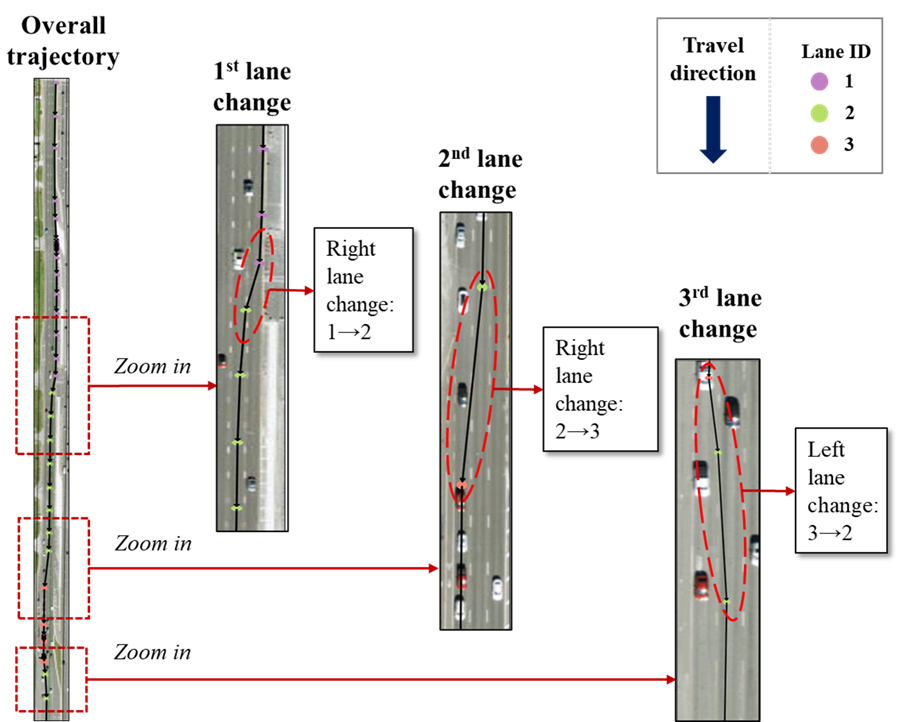
Frequent crashes on urban arterial segments pose significant safety and mobility concerns. While existing safety studies primarily focus on macro infrastructure and traffic features, ignoring the critical influences of micro-level risky driving behavior (e.g., lane-changing). To address such gaps, we developed a directional-level segment crash analysis method, leveraging the high-resolution Connected Vehicle (CV) data. A Constrained Gaussian Mixture Method was proposed to identify lane-changing behavior from raw CV trajectories. Micro-level driving behavior features were then extracted considering risky driving behavior, driving volatility, and aggressive speeding. A Bivariate hierarchical negative binomial model was employed to jointly estimate the heterogeneous impacts of driving behavior features on rear-end (RE) and sideswipe (SW) crashes. While a hierarchical zero-inflated Poisson model was utilized to identify significant contributors to speeding crashes. Empirical experiments at Hillsborough County highlight the critical role of risky driving behavior features for segment safety: (1) Segments with a high proportion of free-flow trajectories tend to experience fewer RE and SW crashes. (2) Driving fluctuation of stop-and-go vehicles is positively related to the frequency of RE crashes. (3) Risky right lane-changings coupled with hard accelerations are significantly associated with SW crashes. (4) Aggressive speeding behavior is highly related to speeding crashes.
Recommended citation: Han, L., & Abdel-Aty, M. (2025). Segment level safety analysis using lane-changing behavior and driving volatility features from connected vehicle trajectories. Scientific Reports.
Download Paper