
Innovative Analytic Methods for Crash Research
Within the leading traffic safety research lab—UCF SST, my collaborators and I develop novel crash analytic methods to address complex heterogeneity and spatiotemporal dependencies in crash frequency and severity modeling. These approaches encompass both advanced statistical methods and spatio-temporal machine learning/deep learning methods.
Statistical Methods
With the postdoctoral researcher Dr. Chenzhu Wang and visiting scholar Dr. Zhe Wang, we developed novel statistical methods for crash frequency and severity analysis:
- A Grouped Random-Parameters Poisson-Lindley Model with Spatial Effects to analyze intersection crashes with visual environment features and spatiotemporal variations.
- A Random Parameter Negative Binomial-Lindley Model to study the impacts of visual environment features from Google Street View images on intersection crash frequencies.
- Partially Temporal Constrained Random Parameters Bivariate Probit Models to examine the association between helmet usage and injury severity in moped-vehicle crashes.
- Joint Random Parameters Bivariate Probit Models with Temporal Instability to investigate the impact of speed differences on rear-end crash severity and account for temporal instability during COVID-19.
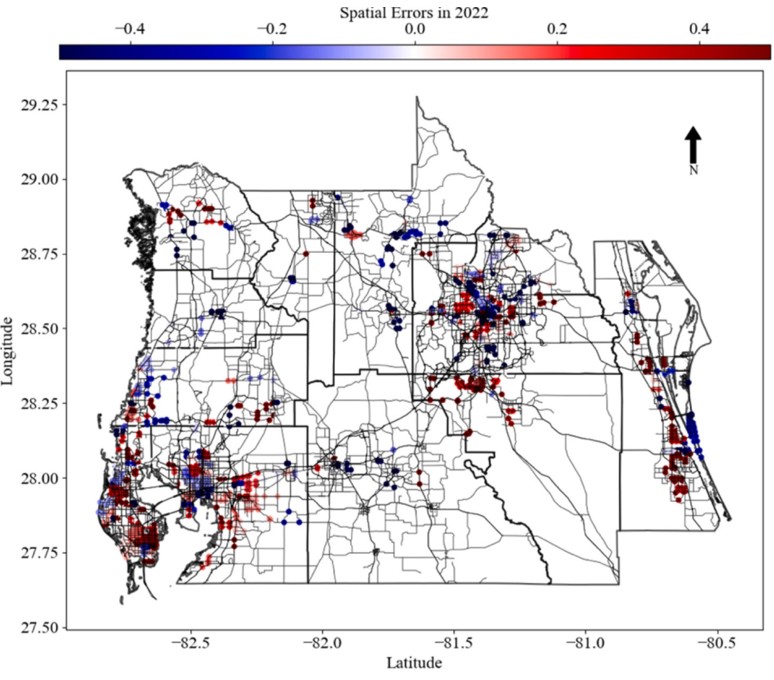
Spatial Errors in Grouped Random-Parameters Poisson-Lindley Model
Related Publications
- Grouped Random Parameters Poisson-Lindley Model with Spatial Effects Addressing Crashes at Intersections: Insights from Visual Environment Features and Spatiotemporal Instability
- Intersection Crash Frequency Analysis Considering Visual Environment Features Using Random Parameter Negative Binomial-Lindley Model
- Effects of Helmet Usage on Moped Riders’ Injury Severity in Moped-Vehicle Crashes: Insights from Partially Temporal Constrained Random Parameters Bivariate Probit Models
- Effects of Speed Difference on Injury Severity of Freeway Rear-End Crashes: Insights from Correlated Joint Random Parameters Bivariate Probit Models and Temporal Instability
ML & DL approaches
With the visiting scholar Dr. Pengfei Cui and postdoctoral researcher Dr. Chenzhu Wang, we developed novel ML models and DL networks for crash frequency and severity analysis:
- A Multiscale Geographical Random Forest (MGRF) as new spatial ML framework to capture multiscale spatial heterogeneity and integrate street-view semantic visual features for traffic safety modeling.
- Using Cross-Stitch Networks on (1) tunnel crash severity and congestion duration joint-modeling, and (2) quantifying the impact of speed differences on injury severities of both vehicles in rear-end crashes.
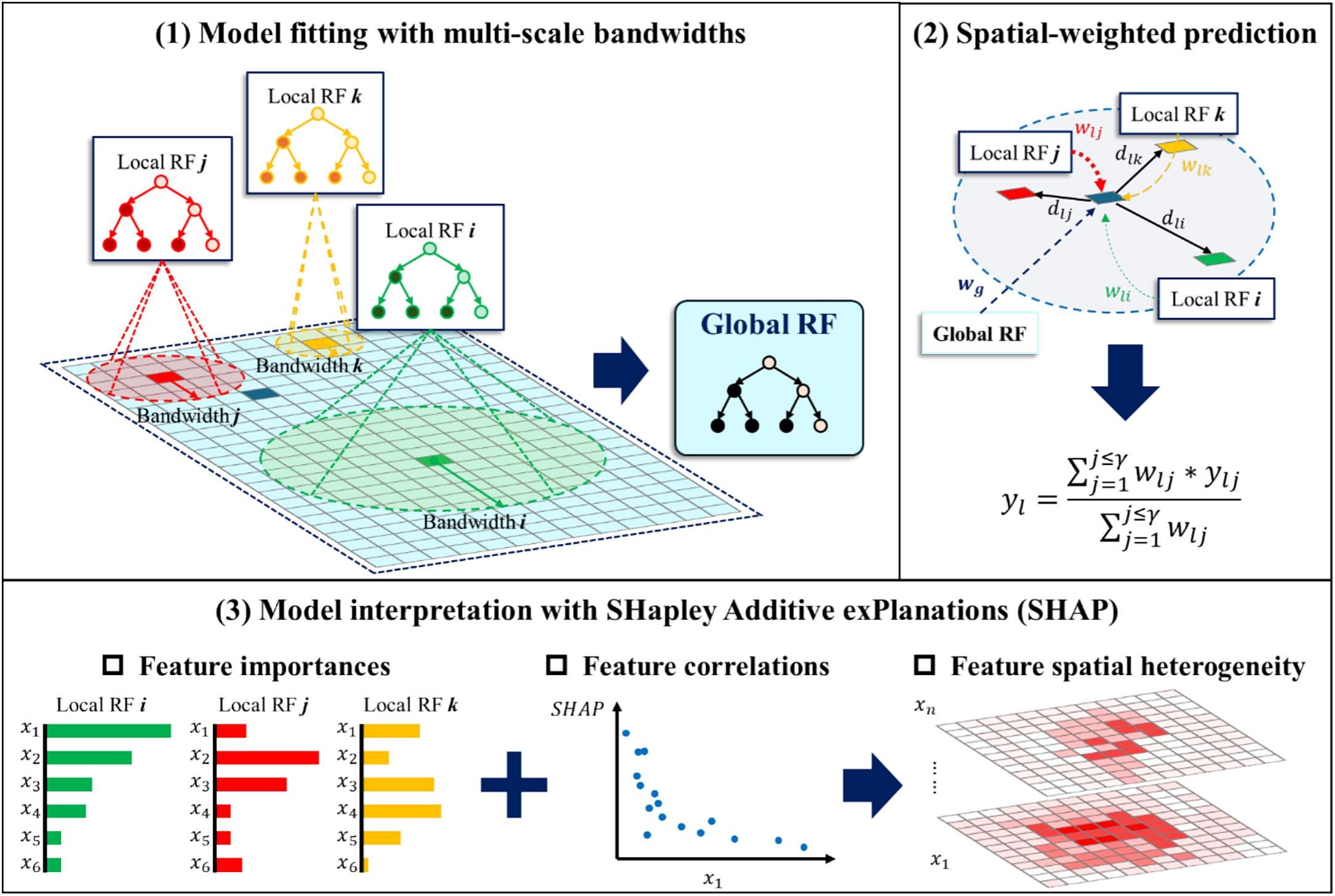
Illustration of Multiscale Geographical Random Forest
Related Publications
- Multiscale Geographical Random Forest: A Novel Spatial ML Approach for Traffic Safety Modeling Integrating Street-View Semantic Visual Features
- Tunnel Crash Severity and Congestion Duration Joint Evaluation Based on Cross-Stitch Networks
- Analyzing Speed-Difference Impact on Freeway Joint Injury Severities of Leading-Following Vehicles Using Statistical and Data-Driven Models